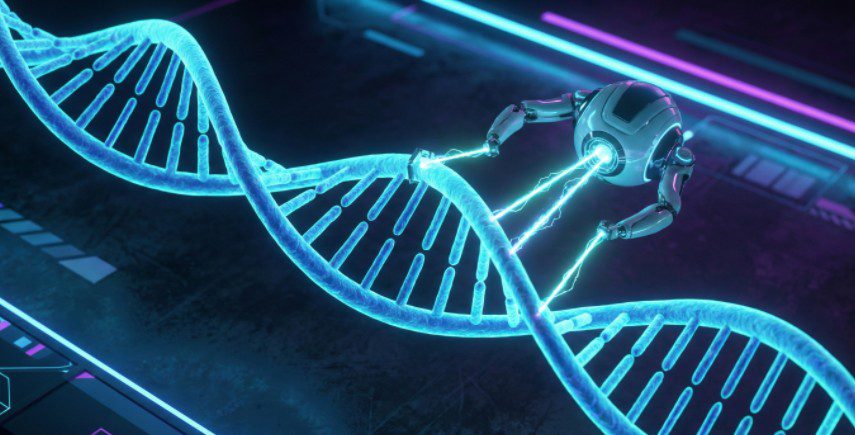
The concept of rewriting the code of life was once pure science fiction. Today, Gene Editing Technology has transitioned from theoretical research to a tangible medical reality. By precisely altering DNA sequences, scientists are now on the verge of eradicating hereditary diseases that have plagued humanity for centuries.
In this deep dive, we explore how CRISPR-Cas9 and next-generation Prime Editing are reshaping healthcare, their synergy with Medical Nanobots, and the profound ethical questions arising from the ability to “design” biology.
What is Gene Editing Technology?
At its core, Gene Editing Technology refers to a set of scientific methods that allow researchers to change an organism’s DNA. These technologies act like molecular scissors, cutting the DNA at specific spots so that genetic material can be added, removed, or altered.
While early methods like Zinc Finger Nucleases (ZFNs) were expensive and difficult to use, the discovery of CRISPR-Cas9 revolutionized the field. It democratized genetic engineering, making it cheaper, faster, and more accurate than ever before. This accessibility has accelerated research into curing genetic disorders such as Sickle Cell Anemia, Cystic Fibrosis, and Huntington’s disease.
CRISPR-Cas9: The Molecular Scissors
CRISPR (Clustered Regularly Interspaced Short Palindromic Repeats) is a mechanism originally found in bacteria as an immune defense against viruses. When adapted for humans, it uses an enzyme called Cas9 to target a specific strand of DNA.
Here is the simplified process:
- Recognition: A guide RNA (gRNA) leads the Cas9 enzyme to the exact location of the gene mutation.
- Cleavage: The Cas9 enzyme cuts the DNA strands at the targeted sequence.
- Repair: The cell’s natural repair machinery kicks in. Scientists can use this moment to introduce a healthy gene template, effectively rewriting the error.
For a deeper technical understanding of CRISPR’s origins, you can refer to the Broad Institute’s guide on CRISPR.
Prime Editing: Precision Beyond CRISPR
While CRISPR-Cas9 is powerful, it carries the risk of “off-target effects”—accidentally cutting the wrong part of the DNA. This is where Prime Editing comes in. Often described as a “search-and-replace” word processor for DNA, Prime Editing offers significantly higher precision.
Unlike classic CRISPR, which breaks both strands of the DNA double helix (risking chaotic mutations), Prime Editing only nicks one strand. It uses a modified Cas9 enzyme fused with reverse transcriptase to directly write new genetic information into the specified site. This evolution allows for the correction of up to 89% of known disease-causing genetic variants, marking a massive leap forward in Gene Editing Technology.
Synergy with 3D Bioprinting and Nanotech
Gene editing does not exist in a vacuum. It is converging with other exponential technologies to create a new paradigm in medicine.
- Organ Regeneration: By combining gene editing with 3D Bioprinting Technology, scientists can edit a patient’s own cells to remove genetic defects before printing them into functional tissues or organs. This eliminates the risk of transplant rejection.
- Delivery Systems: The biggest challenge in gene therapy is delivery. How do you get the editing tools into the right cells? This is where advancements in nanomedicine come into play. Future therapies may utilize programmed nanocarriers to deliver CRISPR components directly to the affected organ, minimizing systemic side effects.
The Ethical Dilemma: Designer Babies
The power to edit the human genome brings unprecedented ethical challenges. Somatic gene editing, which affects only the patient, is generally accepted as a therapeutic tool. However, Germline editing—altering the DNA of embryos, sperm, or eggs—changes the genetic makeup of future generations.
This raises critical questions:
- Inequality: Will Gene Editing Technology be available to everyone, or will it create a biological caste system where the wealthy can purchase genetic enhancements (intelligence, physical traits) for their children?
- Unintended Consequences: Changing the gene pool could introduce unforeseen mutations that propagate through generations.
- Consent: Future generations cannot consent to the genetic modifications made by their ancestors.
Conclusion
Gene Editing Technology is arguably the most transformative breakthrough in modern biological history. From curing incurable diseases to improving agricultural resilience, the potential is limitless. As we move from the era of “treating” diseases to “editing” them out of existence, the focus must shift to rigorous safety standards and ethical governance. The code of life is now open source; how we choose to write the next chapter will define the future of humanity.
Leave a Reply