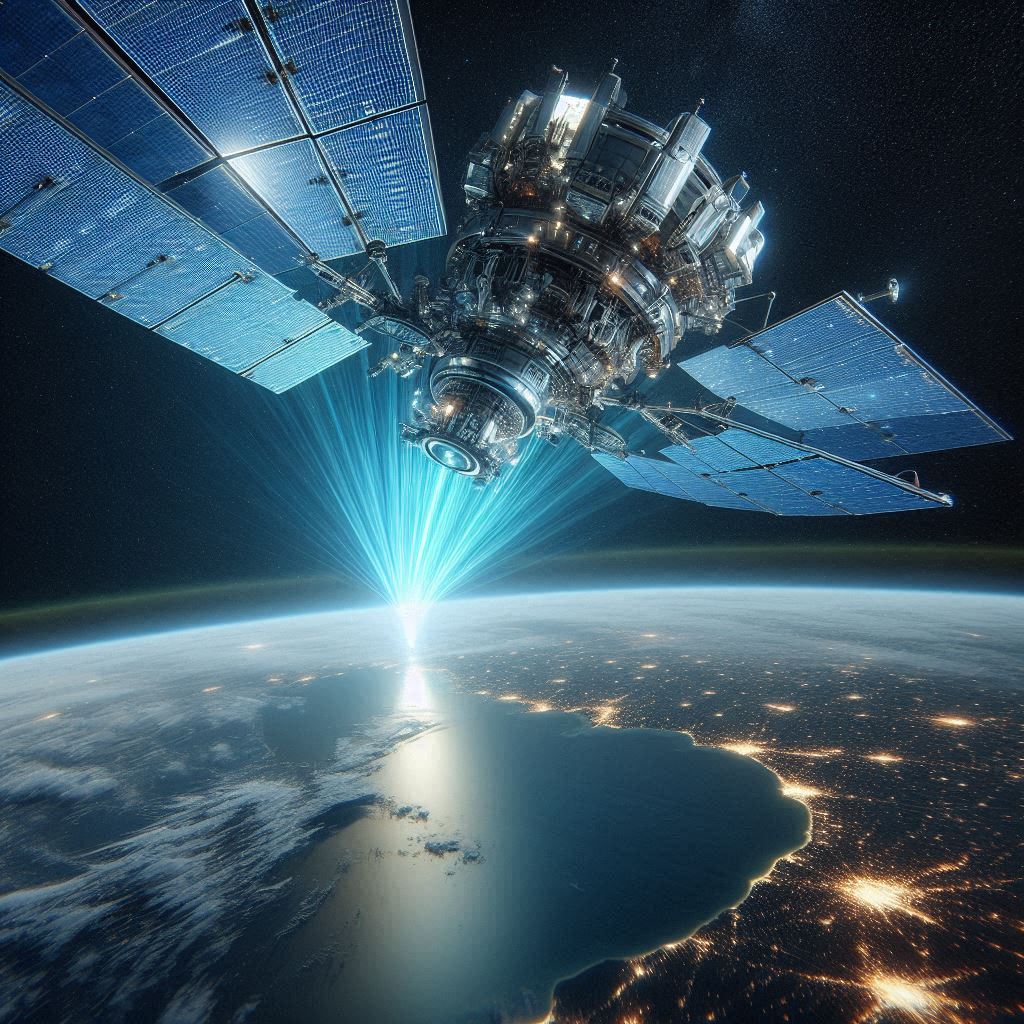
Space-Based Solar Power (SBSP) represents the holy grail of renewable energy: a limitless, clean power source that operates 24/7, regardless of weather, day, or night. Unlike terrestrial solar farms, which are limited by the atmosphere and the rotation of the Earth, satellites in geostationary orbit face the sun constantly. As the global demand for clean energy intensifies in 2026, the concept of harvesting solar energy in space and beaming it wirelessly to Earth is transitioning from science fiction to a tangible engineering reality.
In this analysis, we explore the mechanics of SBSP, its integration with Wireless Power Transmission, and the critical hurdles—such as launch costs and orbital congestion—that agencies like ESA and JAXA are working to overcome.
How Space-Based Solar Power Works
The fundamental concept of Space-Based Solar Power is straightforward, yet the engineering is monumental. The system consists of three main stages:
- Collection: Massive arrays of photovoltaic (PV) panels are deployed in high Earth orbit (GEO), where sunlight is up to 144% more intense than on the Earth’s surface.
- Conversion: The harvested DC electricity is converted into microwaves or laser beams.
- Transmission: This energy is beamed down to a specific “rectenna” (rectifying antenna) station on Earth, which converts the waves back into electricity for the grid.
This process relies heavily on advanced Wireless Power Transmission technologies. Without efficient long-distance beaming capabilities, the energy loss during transmission would make the project economically unviable. Recent breakthroughs in phased array antennas have significantly improved focusing efficiency, minimizing dispersion over the 36,000 km distance.
Why We Need Solar Power from Space
The primary limitation of current renewable energy sources is intermittency. The wind doesn’t always blow, and the sun doesn’t shine at night. SBSP solves this “baseload” problem.
- Continuous Power: A satellite in GEO is in Earth’s shadow for only 72 minutes per year during equinoxes. For the remaining 99% of the time, it generates peak power.
- Higher Efficiency: Without atmospheric scattering or absorption (clouds, dust, ozone), solar panels in space operate at much higher efficiencies than those on the ground.
- Flexibility: The beaming satellite can redirect power to different locations on Earth. If a disaster strikes a region, the satellite can target a mobile rectenna to provide emergency power instantly.
Major Challenges: Debris and Cost
Despite its promise, Space-Based Solar Power faces significant hurdles. The most pressing is the sheer cost of launching thousands of tons of hardware into orbit. While reusable rockets (like Starship) have drastically lowered costs, building kilometer-scale structures in space remains expensive.
Furthermore, the issue of Orbital Debris Removal is critical. A solar farm the size of a city is a massive target for space junk. Even a small screw moving at orbital velocity could shatter a solar array. Protecting these assets requires advanced shielding and automated collision avoidance systems, making debris removal technologies a prerequisite for any large-scale SBSP project.
The Global Race for Orbital Energy
In 2026, the race to build the first commercial SBSP plant is heating up. The European Space Agency’s (ESA) Solaris initiative is currently evaluating the feasibility of a gigawatt-scale plant. Meanwhile, nations like China and Japan are testing stratospheric transmission as a stepping stone.
Organizations like the National Space Society (NSS) argue that SBSP is essential for a carbon-neutral future. As launch costs continue to plummet and robotic assembly becomes more sophisticated, the economic case for space solar is finally aligning with the environmental necessity.
Conclusion
Space-Based Solar Power is not just an alternative energy source; it is a paradigm shift in how civilization acquires energy. By tapping into the sun directly at the source, we can bypass the limitations of our planet’s atmosphere. While challenges in orbital logistics and debris management remain, the convergence of wireless transmission efficiency and cheaper space access suggests that the first beam of energy from the stars may soon light up our cities.
Leave a Reply