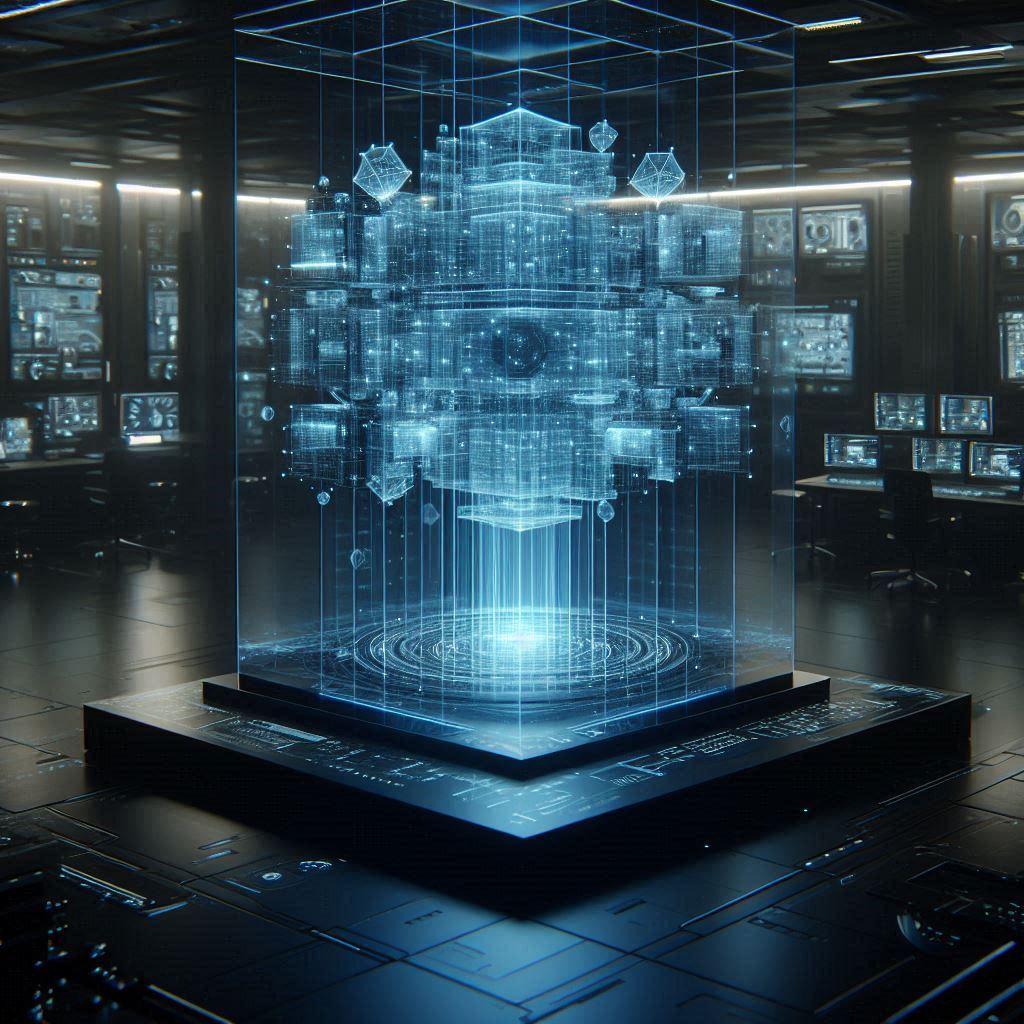
Volumetric Display Technology is the ultimate realization of the science fiction dream: true three-dimensional images floating in mid-air that can be viewed from any angle without special glasses or headsets. While movies like Star Wars and Iron Man have popularized the concept of holograms, real-world volumetric displays are taking a different, more tangible approach to creating 3D imagery. Unlike traditional screens that use pixels to trick the eye, this technology uses “voxels” to physically occupy space.
In this deep dive, we will explore how volumetric displays work, how they differ from VR and standard holograms, and why they are poised to revolutionize industries ranging from medical imaging to air traffic control.
The Science of Voxels: Beyond the 2D Screen
To understand the revolutionary nature of Volumetric Display Technology, we must first distinguish between a “pixel” and a “voxel.” A pixel (picture element) is a point on a 2D grid, possessing coordinates of X and Y. Even the most advanced 3D movies or VR headsets are essentially showing you two slightly different 2D images to create an illusion of depth.
A voxel (volume element), however, adds the Z-axis. In a volumetric display, light is emitted, scattered, or relayed from defined points in x, y, and z coordinates. This means the image has physical depth. You can walk around a volumetric projection of a human heart or a terrain map and see the back of it, just as you would with a real physical object. There is no vergence-accommodation conflict—a common cause of motion sickness in VR—because your eyes focus on the light exactly where it appears to be in space.
Types of Volumetric Displays
Currently, engineers are developing several methods to achieve this effect, but they generally fall into two main categories:
1. Swept-Volume Displays
This is the most common form of early volumetric tech. It uses a high-speed rotating surface—often a flat screen, a mirror, or a helix—within a glass enclosure. By projecting 2D slices of an image onto this surface as it spins at over 900 RPM, the phenomenon of “persistence of vision” blends these slices into a single, cohesive 3D object. While effective, these displays often require moving mechanical parts and are usually enclosed in a sphere or cylinder.
2. Static Volume Displays
This is considered the “Holy Grail.” These displays have no moving parts. Instead, they use lasers to excite atoms within a medium (like a crystal cube, a specialized gas, or even plain air). When two laser beams intersect at a specific point, they ionize the air, creating a glowing point of plasma. This allows for free-floating images that appear to exist in thin air, without any glass enclosure.
For a comparison with the highest quality 2D screens currently available, you can refer to our analysis on Micro-LED Technology , which offers superior brightness for flat surfaces but lacks this true spatial depth.
Medical Imaging: The Killer App
While gaming and entertainment are obvious applications, the most critical use case for Volumetric Display Technology lies in healthcare. Modern medical imaging tools like MRI (Magnetic Resonance Imaging) and CT scans capture data in three dimensions. However, doctors are forced to view this rich 3D data on flat 2D monitors, mentally reconstructing the depth and spatial relationships of organs and tumors.
With a volumetric display, a surgical team can visualize a patient’s anatomy in true 3D space before making an incision. They can rotate the image, zoom in on a specific artery, and discuss the surgical path collaboratively without wearing isolating VR headsets. Research published by SPIE (The International Society for Optics and Photonics) highlights how volumetric visualization significantly reduces error rates in complex neurosurgeries.
Situational Awareness: Military and Aviation
In high-stakes environments like air traffic control towers or military command centers, understanding the precise location of objects in 3D space is a matter of life and death.
- Air Traffic Control: A 2D radar screen requires controllers to constantly read altitude numbers and mentally visualize flight paths. A volumetric display acts like a “digital fish tank,” showing aircraft at their relative altitudes. If two planes are on a collision course, it is visually instantaneous and obvious.
- Battlefield Strategy: Commanders can view a real-time, holographic-style topographic map of the battlefield. They can see the height of mountains, the depth of valleys, and the position of units in real-time, allowing for intuitive strategic planning that 2D maps simply cannot provide.
The Engineering Challenges: Bandwidth and Processing
Why aren’t we all using volumetric smartphones yet? The primary barrier is the sheer volume of data. A 4K screen contains roughly 8 million pixels. A volumetric display with similar resolution density in a cubic volume could easily require billions of voxels.
Rendering and transmitting this amount of data in real-time requires immense computational power and ultra-wide bandwidth. This is why the rollout of 6G networks and advanced GPU architectures is a prerequisite for consumer adoption. The data stream for a live volumetric video conference would be thousands of times larger than a standard Zoom call.
The Future of Volumetric Display Technology
We are currently in the transition phase. Early prototypes are moving from research labs to specialized industrial applications. As laser precision improves and AI-driven rendering techniques reduce the computational load, the hardware is becoming smaller and more affordable.
In the next decade, we expect to see Volumetric Display Technology merge with haptic feedback, allowing users to not only see and walk around digital objects but potentially “feel” them using focused ultrasound waves. This technology represents the final frontier of visual communication, breaking the glass wall that has separated the digital and physical worlds for the last half-century.
Leave a Reply