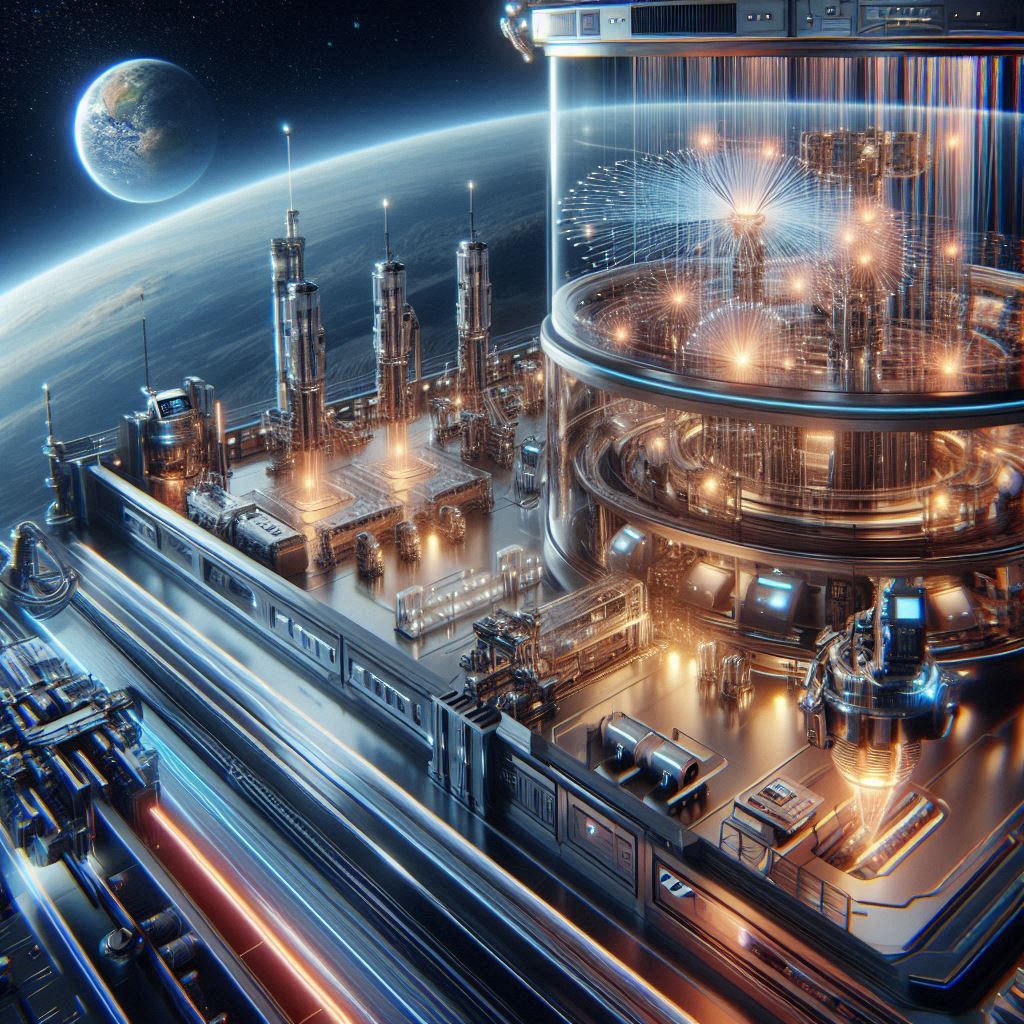
In-Space Manufacturing is rapidly evolving from science fiction into a commercially viable sector, promising to revolutionize how we produce everything from fiber optics to human organs. While the concept of building factories in orbit might sound distant, companies like Varda Space Industries and Blue Origin are already demonstrating that microgravity offers a unique manufacturing environment that simply cannot be replicated on Earth.
By eliminating the constraints of gravity, In-Space Manufacturing (ISAM) allows for the creation of flawless materials, perfectly spherical structures, and biological tissues that don’t collapse under their own weight. This shift marks the beginning of the “Space Economy 2.0,” where space is no longer just a place for exploration or satellite communication, but a destination for high-value industrial production. As launch costs plummet with the advent of heavy-lift rockets like Starship, the economic barrier to entry is lowering, opening the floodgates for a new era of orbital industry.
The Microgravity Advantage: Why Manufacture in Space?
The primary driver behind this industry is microgravity. On Earth, gravity causes sedimentation, convection, and buoyancy—forces that can introduce defects into delicate manufacturing processes. In orbit, these forces are effectively removed.
This unique environment allows for the growth of larger, purer protein crystals for pharmaceutical research, which can lead to more effective drugs with fewer side effects. Additionally, without the pull of gravity, liquids can form perfect spheres, and materials can be mixed without separating into layers based on density. This capability is crucial for creating advanced alloys and foams that are lighter yet stronger than anything produced terrestrially. The absence of atmosphere (vacuum) is another benefit, providing a pristine environment essential for semiconductor fabrication without the need for expensive terrestrial cleanrooms.
ZBLAN Fiber Optics: Superior Data Transmission
One of the most promising near-term products of In-Space Manufacturing is ZBLAN glass. ZBLAN is a fluoride-based glass that has the potential to transmit data up to 100 times more efficiently than traditional silica-based fiber optics used today.
However, producing ZBLAN on Earth is notoriously difficult. Gravity causes tiny crystals to form within the glass during the cooling process, which scatters light and degrades signal quality. In microgravity, these crystals do not form, resulting in a glass with near-perfect clarity. Just a few kilometers of space-manufactured ZBLAN fiber could revolutionize the telecommunications industry, reducing the need for signal repeaters in undersea cables and drastically lowering the latency of global internet infrastructure.
Bioprinting: Printing Human Organs in Orbit
Perhaps the most life-changing application of In-Space Manufacturing lies in biotechnology. 3D bioprinting—the process of creating cell patterns to form tissue—struggles with gravity on Earth. Soft tissues tend to collapse into puddles before they can set, requiring artificial scaffolding that can complicate cell growth.
In space, cells can be printed in three dimensions without the need for scaffolding. They naturally self-assemble and maintain their structure, allowing for the cultivation of complex tissues and eventually, full-scale human organs. This could one day solve the global organ shortage crisis. Early experiments on the International Space Station (ISS) have already successfully printed cardiac and knee tissue, proving the viability of orbital bioprinting. This sector represents a massive leap forward for regenerative medicine.
The Role of Asteroid Mining and In-Situ Resources
For the industry to scale, it cannot rely solely on materials launched from Earth. This is where the synergy with Asteroid Mining becomes critical. To build large-scale structures, such as orbital habitats or massive solar arrays, we must utilize resources available in space.
Sourcing metals, water, and silicates from asteroids or the Moon drastically reduces the cost of raw materials. Instead of launching heavy steel beams from Earth, we could mine iron in space, refine it in zero-gravity foundries, and 3D print construction components directly in orbit. This “In-Situ Resource Utilization” (ISRU) is the cornerstone of a sustainable space economy, closing the loop between extraction and production.
Challenges and The Future Market
Despite the immense potential, significant challenges remain. The cost of returning finished goods to Earth (downmass) is still high, although reusable spacecraft are driving prices down. Additionally, automated factories must be incredibly reliable, as human maintenance crews are not readily available to fix jammed machinery.
However, the trajectory is clear. As infrastructure matures, we will see a transition from experimental labs on the ISS to dedicated commercial space stations serving as industrial parks. The market for products made in space is projected to reach billions of dollars by the 2030s.
Why In-Space Manufacturing Will Redefine the Economy
In-Space Manufacturing is not just about making better products; it is about expanding the human economic sphere beyond our planet. From superior semiconductors that power the next generation of AI to life-saving biological implants, the products of the future will carry the label “Made in Space.” As we master these technologies, we move one step closer to a self-sustaining civilization among the stars.